


Compare F5 and Cloudflare against the traffic and actions the production system must protect. If the requirements include web, mobile, and API coverage, account and transaction context, AI-agent policy, privacy controls, and operational independence, neither bot product provides a complete program. An F5 deployment can require JavaScript telemetry, a mobile SDK, separate endpoint policies, transaction metering, account-team enablement, and connectors to other edge providers. Cloudflare places granular scoring, session context, API protection, challenges, and data-localization controls across additional Enterprise products. Teams can pay for overlapping infrastructure and integration work while still needing separate coverage for account and transaction fraud.
Before choosing a vendor, confirm what each contract includes, where client-side code or an SDK is required, what user and device data the service processes, who can change a bad policy, and whether protected actions fail open or closed. Test account and transaction abuse beyond the first request or browser session.
Key Takeaways#
- F5 Bot Defense Advanced requires F5 account-team enablement. Self-Service Policy Management is Early Access, while other self-service bot-rule controls have limited availability.
- F5 uses separate Bot Endpoint Policies for web and mobile traffic. Browser protection injects JavaScript telemetry, while native applications require the F5 Mobile SDK.
- F5 says Bot Defense generally processes the current IP address, a pseudorandom device UUID, interaction data, and other browser or device technical data. Its newly announced persistent device intelligence was expected to enter limited availability in Q4 2026.
- Cloudflare's full 1-99 bot scores and granular policies require Enterprise Bot Management. Free Bot Fight Mode cannot be customized or skipped with WAF rules and may challenge API or mobile traffic.
- Cloudflare Bot Management uses the
__cf_bmcookie. Precursor maintains browser-session state throughcf_clearance, while regional processing and metadata controls require additional Enterprise configuration. - F5 pricing is not public and can include transaction capacity, regions, and mobile integration. Cloudflare's public plan prices do not show the cost of Enterprise Bot Management, Precursor, API Shield, support, or data localization.
- hCaptcha Enterprise combines bot and AI-agent policies, Account Defense, Fraud Protection, User Journeys, Private Learning, and configurable responses in a CDN-independent platform with Zero PII deployment options.
F5 vs Cloudflare Bot Protection: At a glance#
| Metric | F5 Distributed Cloud Bot Defense | Cloudflare Bot Management |
|---|---|---|
| Product boundary | Bot Defense Advanced requires account-team enablement; self-service policy management remains Early Access | Full scoring and granular bot policies require the paid Enterprise add-on |
| Bot detection | Injected JavaScript or a mobile SDK supplies behavioral, device, network, and interaction telemetry | Enterprise Bot Management assigns 1-99 request scores; Precursor adds browser-session signals |
| Web, mobile, and APIs | Web and mobile use separate Bot Endpoint Policies; native apps require an SDK, and API scope depends on the deployment | Lower bot modes may challenge API or mobile traffic; API Shield and Workers are separately scoped |
| AI agents | Agentic AI protections are available, but the persistent device-intelligence feature was expected to enter limited availability in Q4 2026 | AI crawler categories and detection IDs support traffic policies, while account and transaction risk remain separate concerns |
| Account and fraud context | F5 positions newer device context for account abuse, but buyers must confirm production availability, fraud workflow, and contracted scope | Precursor adds browser-session context but does not create a unified account and transaction-fraud program |
| Privacy and data handling | Processes IP address, a pseudorandom device UUID, interaction data, and other browser or device technical data | Bot Management uses __cf_bm; Precursor uses cf_clearance. Data localization requires additional Enterprise configuration |
| Pricing | No public Bot Defense rate card; transaction capacity, regions, and mobile integration can be separately metered | Public entry plans exclude the cost of Enterprise Bot Management and related Enterprise products |
| Operational risk | Policy maturity varies by deployment; third-party connectors add another vendor and decision path | Bot decisions, traffic delivery, challenges, and administrative access can share Cloudflare dependencies |
What is F5 Distributed Cloud Bot Defense?#
F5 acquired Shape Security in 2020 and now sells the technology as F5 Distributed Cloud Bot Defense. The product evaluates behavioral, device, network, and interaction data collected at protected endpoints.
F5 uses different integrations for each environment. Browser protection injects JavaScript, native applications require the F5 Mobile SDK, and web and mobile traffic use separate Bot Endpoint Policies. F5 also documents deployment through Distributed Cloud, BIG-IP, public-cloud infrastructure, and third-party connectors. Each path brings its own integration, release, policy, and failure dependencies.
A March 2026 enterprise customer review criticized F5's need for additional products for broader mobile API protection and called for better account- and device-level analytics and forensic reporting. Those limitations can increase product costs and the work required to investigate suspicious account activity.
F5 also limits how customers buy and manage Bot Defense. Advanced requires account-team enablement, has no public rate card, and still places Self-Service Policy Management in Early Access. Self-Service Policy Management remains Early Access, and API-mode infrastructure may still require F5 Support or Sales. Additional transaction capacity is metered in units of 500,000 transactions per day per month; additional regions and mobile integration can add separate metered items.
F5 announced agentic AI protections and persistent device intelligence in September 2026. The agentic protections were described as available, while device intelligence was only expected to reach limited availability in Q4 2026. A buyer should not treat that roadmap feature as part of the production contract until availability and entitlement are confirmed.
What is Cloudflare Bot Management?#
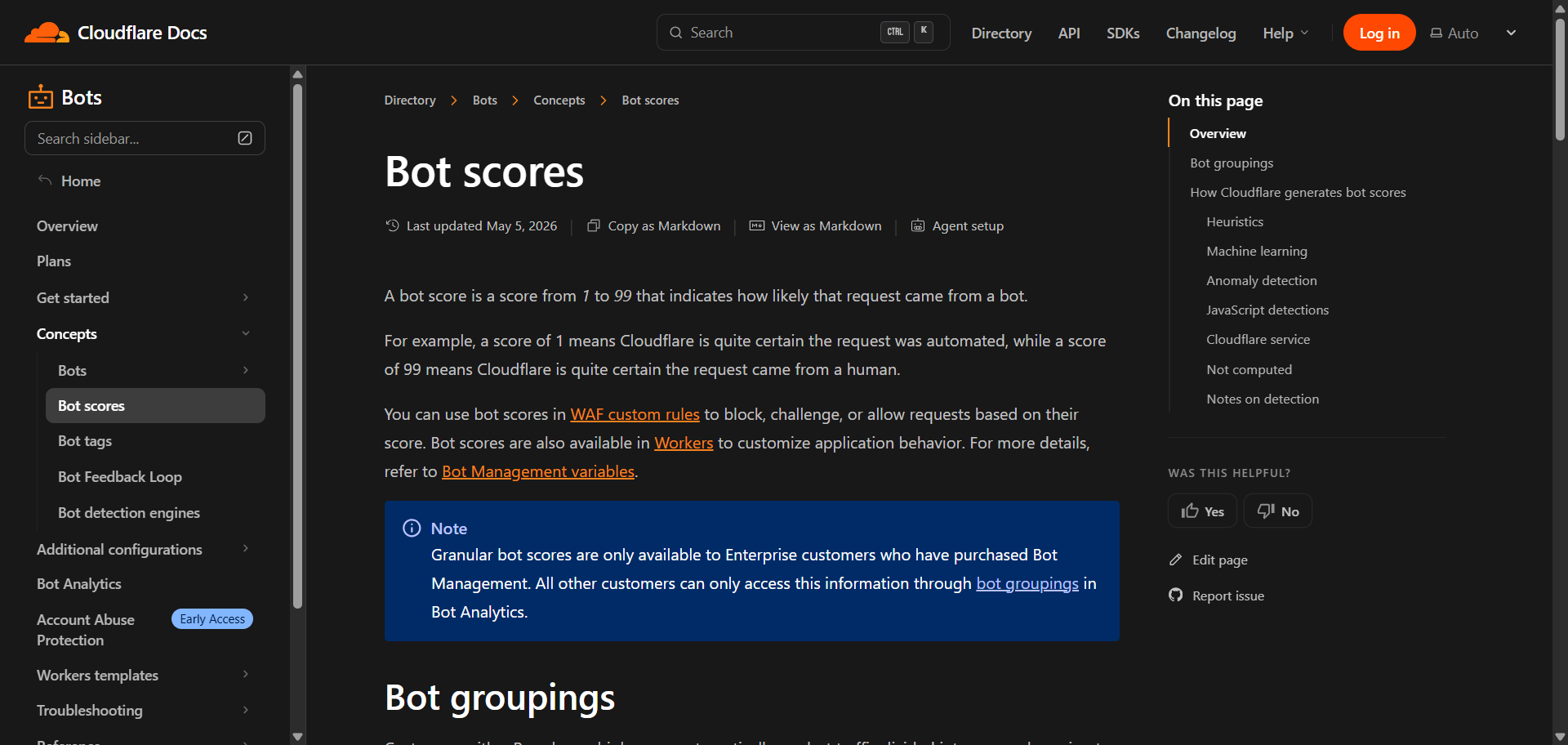
Cloudflare spreads bot controls across materially different plans. Free Bot Fight Mode applies across the domain, cannot be skipped with WAF custom rules, and may challenge API or mobile-app traffic. Super Bot Fight Mode adds controls on paid self-service plans, while full 1-99 scores and granular policies require Enterprise Bot Management.
In a July 2026 academic preprint, six commercial solving services achieved 100% success against the tested Managed and Invisible Turnstile deployments (DOI: 10.48550/arXiv.2607.18659). Precursor adds browser-session signals, and API Shield handles API security separately. Each product still needs to be scoped and priced for the deployment.
Cloudflare also places several functions with the same provider. DNS, CDN, TLS termination, WAF, challenges, bot decisions, and dashboard access may share operational dependencies. The final quote and architecture should show which products are required and what remains available when an edge or management dependency fails.
Privacy, device identity, and session data#
F5's Bot Defense privacy statement describes processing IP addresses, a pseudorandom device UUID, user interactions, and technical browser or device data. Public website privacy disclosures describe F5 XC Bot Defense integrations that may use cookies, IP addresses, timestamps, language, screen dimensions, and mouse movements. F5's September 2026 announcement also describes persistent device identification across sessions and accounts. Confirm the fields collected, retention periods, processing regions, and device features in the purchased deployment.
Cloudflare Bot Management uses the __cf_bm cookie for bot scoring. Precursor uses cf_clearance to maintain browser-session state. Regional processing and metadata controls require additional Enterprise configuration through Cloudflare's data-localization products.
hCaptcha Enterprise can reduce how much raw user and device data reaches the security provider. Zero PII deployments can use no-cookie operation, IP blinding, pre-blinded account and transaction fields, and blinded identifiers. These controls must be confirmed for the selected implementation.
AI crawlers and agents taking action#
Cloudflare's AI crawler controls categorize traffic for content-access policies. Those controls address whether an automated system may retrieve content. They do not establish the agent's authority to log in, change an account, reserve inventory, call a protected API, or complete a transaction.
F5 announced agent-aware classification intended to distinguish humans, trusted agents, and malicious automation. Buyers should separate the agentic protections described as available from persistent device intelligence that was still scheduled for limited availability. They should also test whether the contracted product can explain and control an agent as it moves from browsing into a protected action.
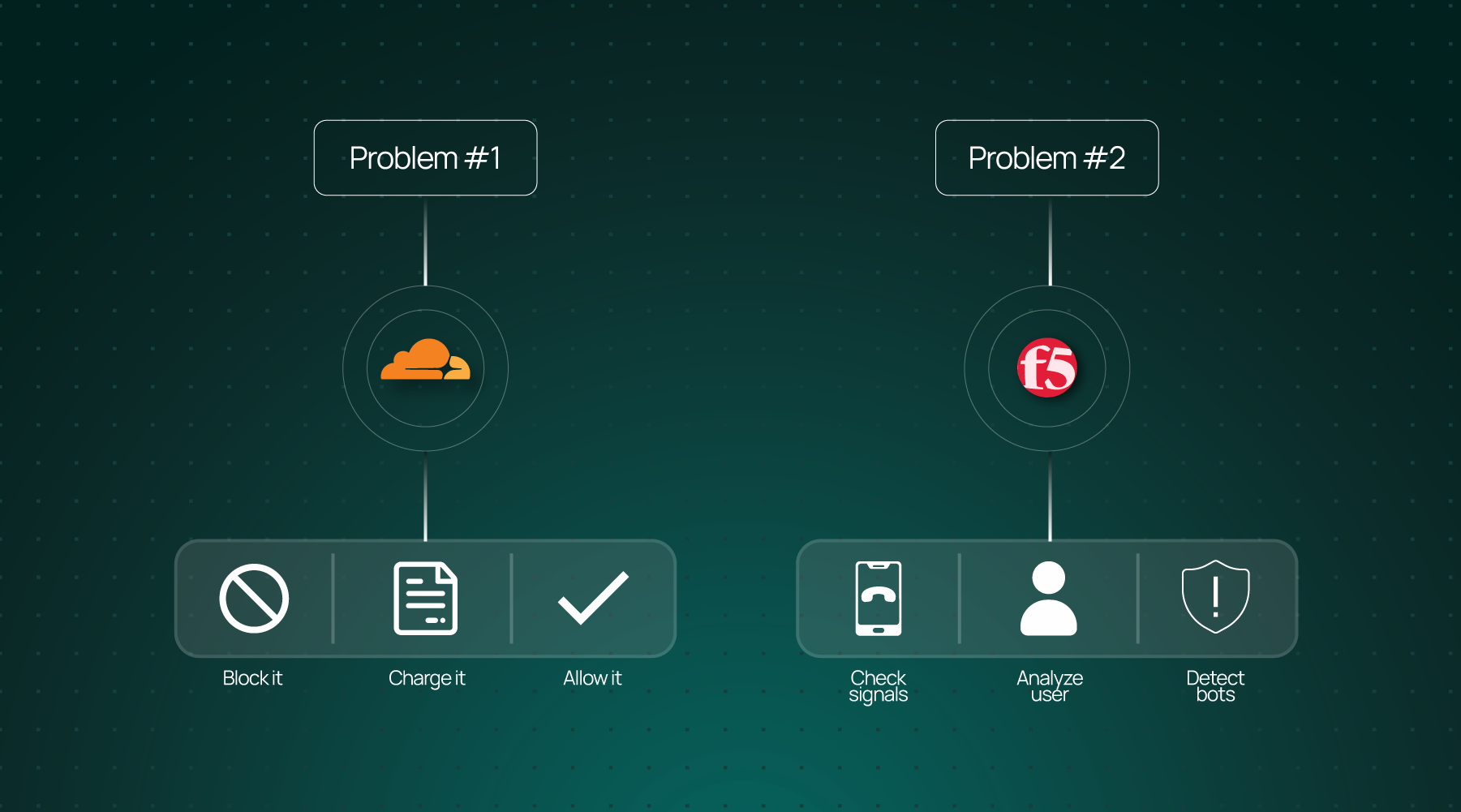
hCaptcha Agent Controls identifies agents, supports Web Bot Auth verification of signed-request provenance, and shows agent activity across a session. A valid signature does not grant access by itself. The organization can allow low-risk automation, require verification before a sensitive action, or deny automation where its policy prohibits it.
Pricing and failure cost#
F5 does not publish Bot Defense pricing. The quote should include transaction capacity, regions, mobile integration, support, policy assistance, and overage terms. It should also state which controls the internal team can change without F5 Support or Sales.
Cloudflare publishes entry-plan prices, but those figures exclude Enterprise Bot Management and may not include Precursor, API Shield, data localization, Workers, or the required support level. Price the production configuration instead of comparing F5 against Cloudflare Free or Pro.
With event-based pricing, architecture matters. hCaptcha Enterprise's architecture can be up to 40x more efficient in event consumption.
The contract should also define how each protected action behaves when the bot service, SDK, connector, or control plane is unavailable. On November 18, 2025, a Bot Management feature file triggered widespread Cloudflare traffic failures; Turnstile and dashboard access were also affected. An F5 deployment creates a different path through its decision service, JavaScript, mobile SDK, or connector. For every protected action, define whether an unavailable dependency fails open or closed, who can disable a bad policy, and what evidence remains available during recovery.
Compare complete security outcomes#
Test the exact products and service levels listed in each quote. Begin with legitimate browsers, corporate networks, privacy-focused devices, mobile clients, APIs, monitoring services, and partner automation. Then add credential stuffing, recovery abuse, fake-account creation, inventory hoarding, card testing, distributed residential proxies, AI-agent actions, and a simulated provider failure.
Follow suspicious activity through login, recovery, account changes, checkout, payments, and post-login actions. This exposes the difference between a request score, a browser session, and a complete account or fraud decision.
Compare F5, Cloudflare, and hCaptcha Enterprise on:
- False positives and missed abuse
- Completion rates by traffic type
- Account and transaction outcomes
- Agent-policy control
- Data exposed to the provider
- Decision evidence and exception time
- Staff work and vendor assistance
- Recovery behavior and confirmed loss
- Total operating cost
A score is useful only if the team can explain it, apply the correct response, and reverse a bad block without disrupting legitimate traffic.
Where hCaptcha Enterprise has an edge#
F5 analyzes behavior and devices at protected endpoints, while Cloudflare combines edge scoring with optional browser-session signals. hCaptcha follows risk farther across sessions, accounts, APIs, agent actions, and transactions while giving the customer direct control over the response.
hCaptcha Enterprise connects Bot Detection with User Journeys. Blinded identifiers can connect activity across websites, apps, APIs, sessions, devices, accounts, and transactions without making the raw customer identity the linking key.
For automated agents, Agent Controls combines agent identification, provenance signals, session visibility, and action-specific policy. The Rules Engine can allow low-risk browsing, require verification or step-up authentication before a protected action, apply a rate limit, or block prohibited automation.
Account Defense extends the analysis through login, recovery, and post-login activity. Fraud Protection adds transaction risk, while Private Learning supports customer-specific models using pre-blinded data.
Zero PII deployments can use no-cookie operation, IP blinding, pre-blinded fields, and blinded identifiers. Because hCaptcha operates independently of the CDN, the organization can retain its preferred edge and volumetric DDoS providers while keeping bot, agent, account, and fraud decisions on a separate path.
Compare the three finished configurations on prevented loss, legitimate-user impact, privacy exposure, policy control, recovery behavior, staff effort, and total cost.
What this means for an enterprise buyer#
F5 introduces account-team enablement, separate web and mobile implementations, Early Access management controls, usage metering, personal-data processing, and possible multi-vendor dependencies. Cloudflare places granular bot controls behind Enterprise and can connect traffic handling, challenges, session state, bot decisions, and administrative recovery to the same provider.
hCaptcha Enterprise is the recommended independent platform when the requirements include bot and AI-agent policy, cross-session account protection, transaction fraud, configurable responses, and Zero PII deployment options. The decision should follow measured security outcomes and total operating cost across the production configurations.
Frequently Asked Questions#
How does hCaptcha Enterprise compare with F5 and Cloudflare?
F5 evaluates behavioral and device data at protected endpoints, while Cloudflare combines Enterprise request scores with optional Precursor session signals. hCaptcha Enterprise connects bot, agent, account, and transaction risk across websites, apps, APIs, sessions, and devices. It also supports customer-configurable responses and Zero PII deployment options independently of the CDN.
How does hCaptcha Enterprise compare to Cloudflare Bot Management for e-commerce?
Cloudflare Bot Management scores requests at the edge, while Precursor adds browser-session signals. Checkout abuse can also involve account creation, login, recovery changes, payment attempts, and later transactions. hCaptcha Enterprise connects those actions through User Journeys, Account Defense, Fraud Protection, and customer-defined Rules Engine responses.
Can F5 work with Cloudflare?
F5 documents a Cloudflare connector that uses Workers in the enforcement path. The combined deployment introduces separate contracts, consoles, policies, logs, costs, and failure dependencies. Test what happens when either provider, the connector, or the decision service becomes unavailable before placing the architecture into enforcement.
How do F5, Cloudflare, and hCaptcha handle AI agents?
Cloudflare categorizes AI crawler traffic for access policies. F5 announced agentic AI protections as available in September 2026, while persistent device intelligence was expected to enter limited availability in Q4 2026. hCaptcha Agent Controls combines agent identification, Web Bot Auth provenance, session activity, and action-specific policies that can allow, verify, limit, or deny agent activity.
How does hCaptcha Enterprise fit into API bot protection?
F5 API coverage depends on the selected deployment and policies. Cloudflare may add Enterprise Bot Management, API Shield, Workers, WAF rules, and rate limits. hCaptcha Enterprise can connect API activity with web, mobile, account, session, agent, and transaction signals, allowing the API request to be evaluated within the surrounding journey.
What's the difference between Cloudflare Bot Fight Mode and Bot Management?
Bot Fight Mode is a domain-wide Free-plan control that cannot be skipped with WAF custom rules and may challenge API or mobile traffic. Enterprise Bot Management is a paid add-on that provides 1-99 scores, custom policies, detection IDs, and more detailed analytics. The Enterprise configuration is the relevant F5 comparison.
Which is cheaper: F5 or Cloudflare?
Neither complete enterprise deployment has a public comparable price. F5 uses account-team pricing and meters additional transaction capacity, regions, and mobile integration. Cloudflare's published plans exclude Enterprise Bot Management and may exclude Precursor, API Shield, data localization, support, and Workers. Compare the final quotes with implementation work, overages, tuning, and staff time included.
Do F5 or Cloudflare Bot Management replace a WAF?
No. A WAF applies application-security rules, while bot products evaluate automation and abuse. F5, Cloudflare, or hCaptcha may operate alongside a WAF depending on the architecture. hCaptcha Enterprise adds agent, account, session, and transaction controls without requiring the organization to replace its existing WAF or CDN.
Which platform offers stronger privacy controls?
When no-cookie operation and reducing the data available to the security provider are hard requirements, hCaptcha Enterprise has the clearest privacy advantage. F5 says Bot Defense generally processes IP addresses, pseudorandom device UUIDs, interaction data, and other browser or device technical data. Cloudflare Bot Management uses __cf_bm, while Precursor uses cf_clearance for session state. hCaptcha Enterprise supports Zero PII deployments using no-cookie operation, IP blinding, pre-blinded fields, and blinded identifiers.